
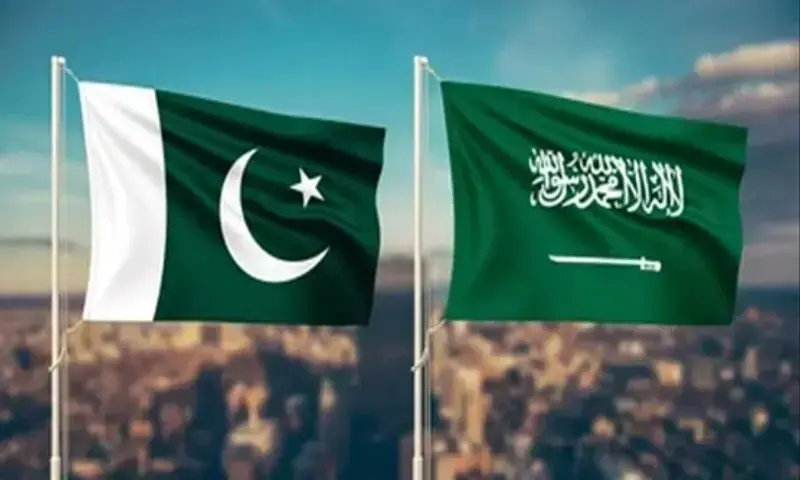
Military consultations between Islamabad and Riyadh following Iranian drone and missile strikes on Saudi territory highlight the delicate strategic balance Pakistan must maintain as the Iran conflict expands beyond its original theatre and begins to affect the security of Gulf states.
The statement issued by Inter-Services Public Relations (ISPR) after the meeting between the Chief of Defence Forces (CDF) and Chief of the Army Staff (COAS) Field Marshal Asim Munir, and Saudi Defence Minister Khalid bin Salman, on its face, looks fairly routine and predictable, but when read closely, a careful calibration of language by Pakistan becomes obvious.
The Pakistani statement acknowledged the gravity of the situation arising from Iranian drone and missile attacks on the Kingdom and noted that CDF Munir discussed with the Saudi defence minister the measures required to halt them within the framework of the Strategic Mutual Defence Agreement (SMDA) between the two countries.
This in itself was a signal of solidarity with Riyadh at a time when Saudi territory is coming under direct military pressure.
Yet even as the statement recognised the attacks and spoke of measures needed to stop them, it refrained from adopting the sharper tone that Riyadh used in its own version of the meeting.
The Saudi statement plainly spoke of Iranian attacks on the Kingdom and the need to halt them, whereas the Pakistani formulation moved immediately to mention the call for restraint and prudence, while expressing hope that the “brotherly country Iran” would manifest wisdom and avoid miscalculation.
This difference in phrasing of the statements was not accidental; it rather reflected Islamabad’s longstanding diplomatic instinct to avoid being drawn into regional rivalries that could destabilise its own security environment. Pakistan shares a sensitive border with Iran and has to consider domestic sensitivities as well.
But at the same time, Islamabad cannot appear indifferent when Saudi Arabia faces military pressure, because relations with Riyadh remain strategically important in economic, political, and defence terms and have historically involved extensive military cooperation, including training, advisory roles, and defence collaboration.
For decades, Pakistan maintained a quiet but substantial defence relationship with Saudi Arabia, which was last September formalised as a mutual defence agreement.
Details of the agreement are not publicly available.
Therefore, it would be interesting to watch out if it covered strictly attacks against Saudi Arabia or third-party sites on Saudi soil that are seen as a threat by the other actor.
The reference in the statement to joint measures being discussed within the framework of the SMDA indicates that consultations are taking place at the security level. This does not necessarily imply that Pakistan will become directly involved in military operations, but it does indicate that the existing defence architecture between the two countries is being activated for coordination and assessment of the situation.
Earlier in the week, Deputy Prime Minister and Foreign Minister Ishaq Dar disclosed that immediately after the start of retaliatory strikes against US aggression, he reminded Tehran to be mindful of Pakistan’s SMDA with the Kingdom.
Dar suggested that Iranians sought Saudi assurances, which he was able to secure and convey to Tehran. Nevertheless, Iran has continued to launch strikes against US infrastructure in Saudi Arabia.
The language of the states, therefore, reveals a familiar Pakistani strategy which attempts to combine reassurance to Saudi Arabia with caution towards Iran, offering solidarity without committing to escalation.
The crux of the message from Islamabad is that while it recognises Saudi security concerns and remains engaged within the bilateral defence framework, it prefers de-escalation and hopes that the crisis will not spiral into a wider regional conflict.
This balancing act is becoming increasingly difficult as the confrontation involving Iran and its adversaries spreads geographically and politically.
What began as a confrontation largely confined to the shadow war between Iran and Israel is now touching the security of the Gulf in ways that raise the possibility of broader regional entanglement. If attacks on Saudi territory intensify or draw in external actors more deeply, the pressure on Pakistan to clarify its position could grow significantly.
Islamabad’s current approach, therefore, reflects both caution and necessity. The country cannot ignore its security partnership with Saudi Arabia nor can it afford a rupture with Iran, and so the language of diplomacy becomes a carefully constructed instrument through which both relationships are managed simultaneously.
The reference to Iran as a brotherly country in the Pakistani statement is particularly revealing because it is not merely a polite diplomatic expression but a signal that Islamabad wishes to keep open channels with Tehran and avoid being placed in the camp of confrontation.
In a moment of rising regional tension, such phrasing is intended to communicate that Pakistan sees the present crisis not as an opportunity for alignment but as a situation requiring restraint and careful political management.
In the language of diplomacy, this is a message delivered on multiple levels at once. It tells Saudi Arabia that Pakistan remains attentive to its security concerns and continues to engage within their strategic partnership.
It tells Iran that Islamabad seeks restraint and does not wish the crisis to deepen. And it tells the wider region that Pakistan would prefer the confrontation to return to the domain of political negotiation rather than expand into a broader military conflict.
The reality is that what comes next in Pakistan- Saudi defence pact would not be decided by Islamabad or Riyadh, it would depend more on what Washington and Tehran do from here onwards.

No comments yet. Be the first to comment!